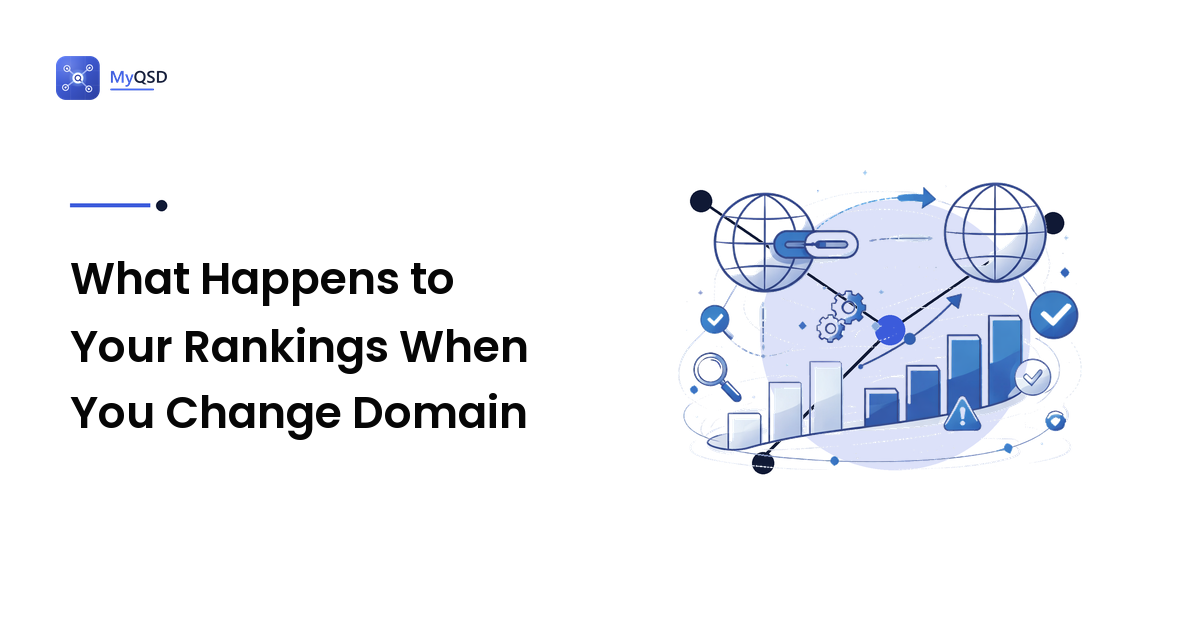
Changing your domain does affect SEO, but not in the way most people fear. Your rankings are not stored on your domain like files on a hard drive, waiting to be deleted the moment you switch. They are recalculated — continuously, for every query — from signals that happen to be attached to a set of URLs. Change the domain and you haven't destroyed those signals; you've moved the address they point to and asked the search engine to work out where everything went.
The takeaway up front: a clean domain change usually costs you a temporary dip and recovers, while a sloppy one costs you the accumulated authority of every page you failed to account for. The variable is not luck. It's how completely and how unambiguously you tell search engines that the old address maps to the new one. This article explains what is actually happening under the hood during that period — so you can judge whether a domain change is worth it, and read the aftermath without panicking.
Rankings are attached to URLs, not to you
It helps to be precise about what you own. When a page ranks, the engine has associated a specific URL with a set of signals: the links pointing at it from other sites, its crawl and indexing history, the internal links feeding it, and the topical context of the hostname it sits on.
Almost all of that is anchored to strings — literal URLs. A backlink earned four years ago points at oldsite.com/guides/pricing. The index holds an entry for oldsite.com/guides/pricing. Your sitemap declares it, your canonical tags confirm it, and a hundred internal links feed it. Change domains and every one of those pointers now aims at a hostname that no longer serves that content. Nothing has been deleted — but the connection between the signals and the content has been severed. The entire job of a domain change is reconnecting them, and the mechanism is the permanent redirect. A 301 is not politeness for human visitors; it is the instruction that tells the engine "this URL's identity has permanently moved here," which is what allows the old page's authority to be attributed to the new page. Redirect properly and the signals follow. Fail to redirect a URL and its signals strand, pointing at a dead address until the engine drops it.
The step-by-step execution side of this — building the old-to-new URL map, running the cutover, filing a Change of Address — is covered in changing domains without losing your search rankings. Here we're staying with the effects.
The phases of a domain change, as the engine experiences them
Nothing about a domain change is instant, because search engines don't watch your DNS. They find out by crawling. That single fact explains almost every strange pattern you'll see in your analytics for the next couple of months.
Discovery: the engine learns the move happened
After cutover, the engine keeps requesting your old URLs on its normal crawl schedule. Each time it hits one, it receives a 301 and learns about one page's new home. Crawl frequency is uneven — your homepage and popular pages get revisited constantly, deep or rarely-updated pages might not be recrawled for weeks. So discovery is gradual and lopsided: the engine knows your top pages moved long before it knows your long tail did.
The swap: old URLs are replaced with new ones
As redirects are discovered, the engine substitutes the new URL for the old one in its index and reassigns the signals. This is where the classic dip appears: for a stretch, some pages exist under the old address, some under the new, and some are in flux — visibility is split across two properties and neither shows its full strength. In Search Console you'll see impressions falling on the old property while they climb on the new one. Those two curves crossing is the most reliable sign the move is working.
Reassessment: the new host has to earn its context
Page-level signals transfer through redirects fairly mechanically. What takes longer is the site-level picture: the engine re-establishes how much it trusts this hostname, how often to crawl it, and how the pages relate to one another. A new domain has no history of its own, so for a while it leans entirely on inherited signals. During this window rankings can wobble in both directions, even when your redirects are flawless.
Settling: normal service resumes
Eventually the old URLs have been fully swapped out, the new host has its own crawl history, and your positions stabilise. For a small site this typically takes weeks; for a large or slowly-crawled one, it can run to a couple of months. You're settled when the old property's index count and impressions have gone flat near zero and the new one behaves like a normal, self-sufficient property.
What actually transfers — and what doesn't
Not everything survives a domain change equally, and knowing the difference sets realistic expectations.
Transfers well through 301s: the authority passed by backlinks pointing at redirected URLs, the topical relevance of the page itself, and the indexing status of each mapped page. This is the bulk of your SEO value, which is why competent migrations recover.
Transfers partially or with a lag: hostname-level trust and crawl budget, both of which the new domain has to build up on its own record even while inheriting the old one's signals. Anything that was ranking on thin margins may not come back at exactly its old position.
Does not transfer at all: anything keyed to your old name rather than your URLs. Direct traffic from people who typed the old domain, bookmarks, email signatures, offline material, third-party listings and profiles that hardcode the old address, and — significantly — brand searches for the old name. If your old domain contained your brand or a keyword that people searched, that recognition doesn't move with a redirect. You have to rebuild it.
That last category is the one people forget. The SEO part of a domain change is a solved engineering problem; the brand part is a marketing project that runs for months afterward.
What determines how hard you're hit
Two sites can run the same migration and get very different outcomes. The variables that matter most:
- Redirect coverage. The single biggest factor. Every valuable old URL needs its own destination. Pages you forget — orphaned posts that still hold links, old landing pages, anything not in your sitemap — lose their equity entirely, and you often won't notice until a quarterly traffic review.
- Redirect precision. Mapping every old URL to the new homepage instead of its true counterpart is functionally the same as deleting those pages; the engine reads an irrelevant redirect as a soft 404 and passes little through. One-to-one mapping is what preserves value.
- How much else you change at the same time. Changing domain and redesigning and restructuring URLs at once compounds the risk and makes diagnosis impossible — if something breaks, you won't know which change caused it. Move first, change later.
- Whether the old domain keeps resolving. Redirects only fire while the old domain is registered, renewed and pointed at your rules. Letting it lapse a year later retroactively breaks the migration and strands every backlink again.
- Site size and crawl rate. A ten-page site can be fully re-crawled quickly. A site with tens of thousands of URLs is discovered in waves, so its dip is longer and shallower.
Reading the aftermath: normal dip versus real damage
The hardest part of a domain change is the weeks afterward, when you have to distinguish an expected transition from a genuine fault. The distinction is behavioural.
A normal dip trends. Traffic drops, then begins recovering as old URLs get swapped for new ones. Old-property impressions fall while new-property impressions rise. Coverage reports show new URLs being indexed steadily. Positions fluctuate but the direction of travel is upward.
Real damage plateaus. Traffic falls and stays flat at the bottom with no recovery curve. Look for concrete causes rather than theorising: old URLs returning 404 rather than 301, redirect chains stacking hops instead of pointing straight at the destination, a staging noindex shipped to production, canonical tags still naming the old domain, or a large block of URLs all landing on the homepage. These are mechanical faults with mechanical fixes.
The discipline during the dip is to verify the plumbing and then leave the content alone. Rewriting pages or chasing new links mid-transition adds fresh variables to a system already re-evaluating everything, and makes recovery harder to read.
FAQ
Does changing domain affect SEO permanently?
Not if the move is executed properly. A complete set of one-to-one 301 redirects transfers the authority attached to your old URLs, so rankings typically recover to near their previous level. Permanent losses come from missing redirects, redirects pointing to the wrong page, or an old domain that's allowed to expire.
How long do rankings take to recover after a domain change?
It depends on how fast your site gets recrawled. Small sites often stabilise within a few weeks; larger or infrequently-crawled sites can take a couple of months. The useful signal isn't your position on any one keyword — it's whether the new property's impressions are trending up while the old property's fall.
Will I lose all my backlinks if I change my domain name?
The links stay where they are, on other people's sites, still pointing at your old URLs. What matters is whether those URLs redirect. With working 301s the value flows through to the new pages; without them the links point at dead addresses and their value is lost. Updating your highest-value links at the source is still worth doing — a direct link is cleaner than a redirected one.
Is it safer to keep the old domain running alongside the new one?
No. Serving the same content on two domains at once splits your signals and creates duplicate-content ambiguity about which version should rank. Keep the old domain registered and resolving, but have it do nothing except redirect.
Does changing domain reset my site's age or authority?
There's no counter that resets. The new hostname does start without its own history, and it has to build a crawl record and trust profile of its own — but it inherits the page-level signals your redirects carry over. It's less a reset than a transfer that takes time to fully register.
Before you commit
If you're still deciding, weigh the real cost honestly: a temporary dip you can plan for, plus a brand-recognition rebuild the redirects can't do for you. If the new domain is genuinely better — clearer, ownable, correctly matched to the business — that's a price worth paying once. If it's a marginal improvement, it usually isn't.
If you've already decided, do the mapping work before you touch a server. Every old URL, its exact new counterpart, one hop, no exceptions. That spreadsheet is the difference between a controlled transfer of authority and an accidental restart. Plan the move properly at MyQSD, and a domain change becomes a scheduled inconvenience rather than a lasting loss.