Most sites do not have a content strategy. They have a content habit — publish something when there is time, chase whatever topic feels urgent, and hope traffic follows. It rarely does. A content strategy is the difference between a pile of articles and a library that compounds: a deliberate plan for what you publish, why, in what order, and how each piece supports the others and the business behind them.
The takeaway up front: decide which topics your site should own, group them into clusters built around a central pillar page, plan each piece with a short brief before anyone writes a word, and measure what earns visibility so you know what to double down on and what to prune. Strategy is not more content — it is the right content, structured so the whole is worth more than the sum of its posts.
What a content strategy actually is
A content strategy answers four questions before you write anything: Who are we writing for? What do they search for? What do we want them to do? And how will we know it worked? Skip those and you get busy work — pages that individually look fine but never accumulate into authority on any subject.
The goal is topical authority: becoming, in both a reader's eyes and a search engine's, a site that comprehensively covers a subject. Search engines reward depth and coverage because a site that answers a question and its dozen follow-ups is more useful than one that answers a single query and stops. You earn that reputation by covering a topic thoroughly and connecting the pieces — not by publishing scattered one-offs across unrelated themes.
Start from the business, then the audience
Strategy runs backwards from a goal. Before topics, be honest about what the content is for: leads, sign-ups, sales, support deflection, or simply becoming the reference people trust in your field. That purpose decides which topics are worth your time, because a page that ranks but never advances the business is a vanity result.
From the goal, define the audience and the problems they are trying to solve. List the real questions they ask at each stage — early, when they are learning; middle, when they are comparing options; late, when they are ready to act. Those questions, not your product features, are the raw material of a content plan. Write for the person with a problem, and the business outcome follows.
Turn demand into topics with keyword research
Once you know the audience and their questions, find the language they actually use. That is keyword research, covered in depth in our SEO fundamentals guide: discover the phrases with real demand that you have a realistic chance of ranking for, weigh volume against difficulty, and read the intent behind each query.
For strategy, the crucial move is grouping. Ten variations of the same question belong on one strong page, not ten thin ones. As you cluster phrasings, natural themes emerge — the broad subjects you could plausibly own, each surrounded by the specific questions people ask within it. Those themes become your clusters.
The core model: topic clusters and pillar pages
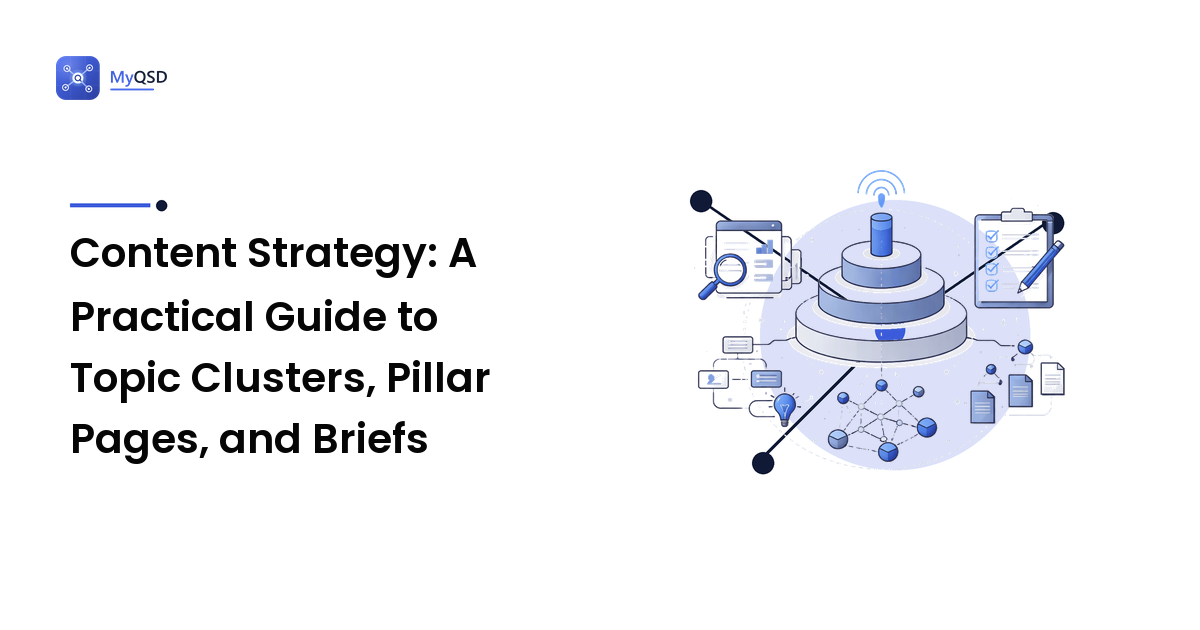
The most durable way to organize content is the topic cluster: one broad pillar page that covers a subject at a high level, surrounded by cluster pages that each go deep on a single subtopic, all linked together.
- The pillar page targets the broad, competitive term and gives a complete overview of the whole subject — the kind of page you are reading now. It is long, foundational, and links out to every supporting piece.
- Cluster pages each target one specific, longer-tail question within the subject and answer it thoroughly. They link up to the pillar, and the pillar links down to them.
This structure works for two reasons. For readers, it is a coherent library: land anywhere and you can navigate to the exact depth you need. For search engines, the internal links and shared subject matter signal that you cover the topic comprehensively, and authority earned by any one page flows through the cluster to lift the others. A single article sits alone; a cluster reinforces itself.
Plan the whole cluster before writing, even if you build it over months. Sketch the pillar and the eight or ten supporting questions around it, and you have a roadmap that keeps every future post pulling in the same direction instead of scattering.
Plan each piece with a brief
The unit of execution is the content brief — a short plan written before the draft that keeps a piece on target. It does not need to be long; it needs to force the important decisions up front. A workable brief captures:
- The primary keyword and the intent behind it. One clear query per page, and the type of page that query rewards — a guide, a comparison, a how-to.
- The audience and the job. Who this is for and what they should understand or do by the end.
- The angle and key points. The handful of sections the piece must cover to genuinely answer the question, plus the obvious follow-ups.
- Internal links. Which pillar this supports and which sibling pages it should connect to.
- The call to action. The single next step the reader should take.
A brief is cheap insurance. It prevents the two most common failures — a page that wanders off its keyword, and a page that duplicates one you already have — and it lets someone else write to a consistent standard.
Build an editorial workflow you can sustain
Strategy dies without a rhythm. The workflow does not need to be elaborate; it needs to be real and repeatable: a backlog of briefed topics, a simple calendar, and clear stages — briefed, drafting, editing, published, and scheduled-for-refresh.
Two disciplines matter more than the tooling. First, cadence over bursts: a steady, sustainable pace beats ten posts one month and none for six, because consistency is what compounds. Second, plan for maintenance, not just publishing. Content is not "done" when it ships. Rankings decay as information ages and competitors improve, so the calendar should reserve time to update and consolidate existing pieces, not only to produce new ones.
Wire the cluster together with internal links
Internal linking is where a plan becomes a system, and it is one of the few ranking levers entirely in your control. Within a cluster, the pattern is deliberate: every cluster page links up to its pillar with descriptive anchor text, the pillar links down to each cluster page, and closely related siblings link across to each other.
This does real work. It helps readers move between related pages, it helps crawlers discover everything you have published, and it distributes authority through the cluster so a strong page lifts its neighbors. Of course, links only help if the pages can be crawled and indexed in the first place — the site-health foundation covered in our technical SEO guide — so a content plan and a healthy site are two halves of the same job.
Measure, then prune and refresh
A strategy you do not measure is a guess. You do not need a wall of dashboards — a few signals tell you what is working:
- Impressions and clicks for each piece: whether it is being shown for its target queries, and whether the title earns the visit.
- Average position for the keywords a cluster targets, tracked over weeks, not days.
- Engagement and conversions: whether the traffic does what the business needs.
Use those signals to act. Pages that never gain traction after a fair run may target the wrong intent, duplicate another page, or address a topic outside your lane — candidates to rewrite, merge, or retire. Pages stuck on page two are often the best investment on the site: a refresh — better depth, a sharper title, a few internal links — can push them onto page one faster than any new article. Prune the dead weight and reinvest in the near-winners, and the library gets stronger without necessarily getting bigger.
Common mistakes to avoid
The recurring failures are easy to name. Publishing without a plan, so nothing accumulates into authority. Chasing high-volume keywords with no realistic chance of ranking instead of winnable, specific ones. Writing thin pages for every keyword variation rather than one strong page per idea. Treating publishing as the finish line and never refreshing. And measuring nothing, so you cannot tell a winner from a waste. Every one of them is a symptom of the same thing — content as a habit rather than a plan.
FAQ
How is a content strategy different from a content calendar?
A calendar is the schedule; a strategy is the reasoning behind it. The strategy decides which topics you should own, how they cluster, and why each piece exists; the calendar just sequences the work. A calendar without a strategy is an organized way to publish disconnected posts.
What is a pillar page, exactly?
A pillar page is a broad, comprehensive page on a core subject that links out to more specific articles covering each subtopic. It targets the main, competitive term and acts as the hub of a topic cluster — the supporting pages link back to it, and it links down to them, so the whole set reinforces one another.
How many articles do I need in a topic cluster?
There is no fixed number — enough to cover the subject's real subtopics thoroughly, which is usually a pillar plus somewhere around six to a dozen supporting pieces. Let the audience's actual questions set the size: cover what people genuinely ask, and stop before you are splitting hairs into thin, overlapping pages.
Should I write the pillar page or the cluster pages first?
Either can come first, but plan the whole cluster before writing any of it. Many teams draft the pillar first to define the subject's scope, then build out supporting pages; others start with a few high-intent cluster pages and add the pillar once the shape is clear. What matters is that they are planned together and linked deliberately.
How often should I update existing content?
Review your important pages on a regular cadence — a light audit a couple of times a year is a reasonable baseline — and refresh whenever a page's rankings slip, its information ages, or a competitor clearly overtakes it. Updating a proven page is often a better use of time than publishing a new one, because you are building on authority you have already earned.
Next step
Pick one subject your site should genuinely own — a topic where you can answer not just the headline question but every follow-up around it. Map that cluster on a single page: the pillar in the middle, the specific questions people ask arranged around it, and the internal links that will tie them together. Write the pillar first, then work through the supporting pieces one brief at a time, and measure each as it lands. Do that, and you stop publishing posts and start building a library that compounds. For more practical, vendor-neutral guidance on content, domains, and search visibility, visit myqsd.com.