If you manage more than a handful of domains, the backlink audit is the chore that never quite gets done. No single tool sees the whole link graph, so an honest picture means pulling signals from several places — search console exports, a couple of backlink indexes, DNS records, the live pages themselves — and reconciling them. By hand, it is an afternoon of copy-paste per domain; done badly, a stale spreadsheet that misses the toxic links you needed to find.
The takeaway up front: a backlink audit is a data-collection problem before it is an SEO problem. The leverage is in consolidating many sources into one repeatable pipeline — fetch, normalize, dedupe, score — so the audit runs the same way every time and you spend your judgment on the findings, not the gathering. This guide walks that pipeline, including the part where one source throws a CAPTCHA at your collector and the run stalls.
Why one source is never enough
Every backlink dataset is a sample. Crawlers index the web at different refresh rates, your search console only shows links Google chose to report, and DNS or registration lookups tell you who owns a referring domain but nothing about its links. Lean on one provider and you inherit its blind spots. So a defensible audit triangulates — a practical source list for one domain:
- First-party data — Google Search Console and Bing Webmaster Tools exports; authoritative for what each engine attributes to you.
- One or two backlink indexes — the large third-party link databases, each with its own crawl coverage.
- Registration and DNS signals — RDAP/WHOIS and DNS records, to spot networks, expired domains, and same-owner footprints.
- The live pages — a light fetch of each referring URL to confirm the link still exists, is followed, and sits in real content.
None of these agrees perfectly, and that is the point: overlap gives confidence; a link only one source reports is a lead to verify.
Consolidate collection into one pipeline
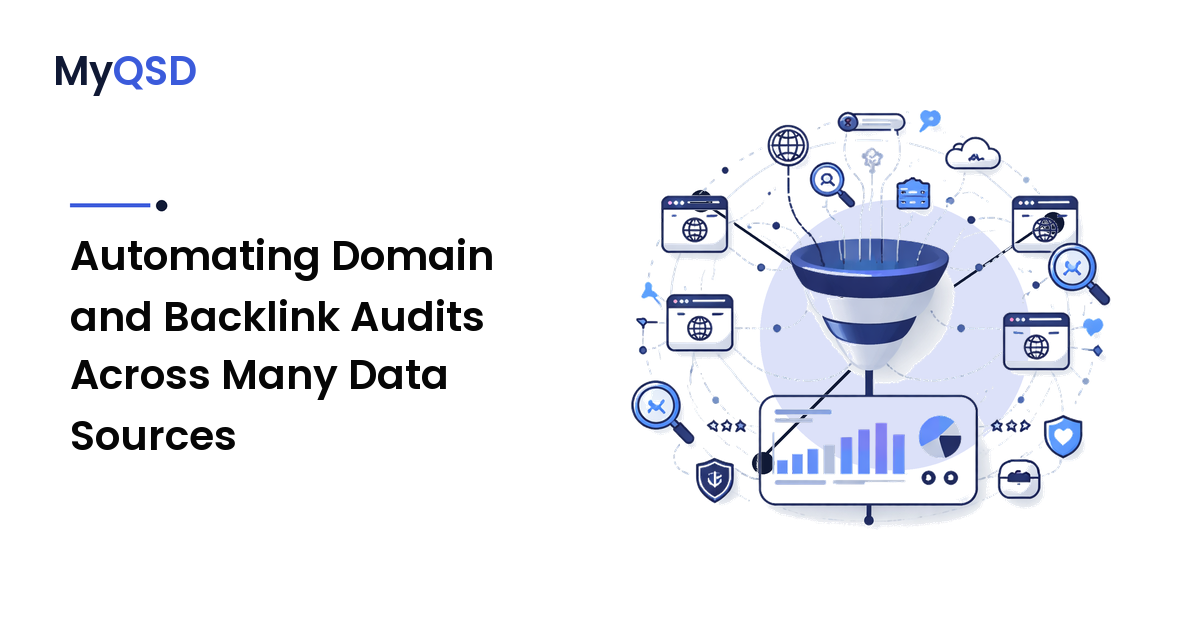
Treat the audit as a pipeline of four stages, each doing one job, so you can rerun any stage without redoing the rest.
- Fetch — pull from each source on its own schedule (APIs return JSON, exports land as CSV, live-page checks return HTML). Keep each raw response untouched so you can re-parse later without re-fetching.
- Normalize — map every source onto one row shape:
source_url,target_url,anchor,rel,first_seen,referring_domain. Normalizing up front makes later steps source-agnostic. - Dedupe and merge — the same link arrives from several sources with slightly different URLs. Canonicalize before you compare: lowercase the host, strip
utm_*and other tracking parameters, resolvehttp/httpsandwww, drop fragments. Then collapse to one record per(referring_domain, target_url)pair, keeping a list of which sources reported it. - Score and report — only now apply judgment, on the signals below. The output is a ranked list — keep, monitor, or disavow — not a raw dump.
This is the same portfolio hygiene you bring to building and auditing a domain portfolio — just automated.
Prefer official and vendor APIs first
Before you write a scraper, exhaust the front doors. Most of what you need has an official interface, and it is the better choice:
- Search console data comes from the Google Search Console API and the Bing Webmaster Tools API — authenticated, rate-limited, stable.
- The major backlink databases sell vendor APIs. Paying for the API rather than scraping the web UI gets you cleaner data, documented fields, and terms that permit programmatic access.
- Domain ownership and DNS come from RDAP (the structured successor to WHOIS) and ordinary DNS queries.
Vendor APIs cost money, but they buy reliability and put you on the right side of each provider's terms. Reach for HTML collection only for what genuinely has no API — typically live-page verification. Keep that fetching gentle: identify your client honestly, respect each site's robots.txt, cache aggressively, and rate-limit so you are a guest, not a load.
When a source throws a CAPTCHA, the pipeline stalls
Here is the failure that quietly breaks an automated audit. You run live-page verification across thousands of referring URLs, and some sit behind an anti-bot wall. Your fetcher gets a challenge page instead of the article, the link is silently logged as "missing," and the audit reports false losses — at volume, even a small share of challenged pages skews the numbers.
The clean fix is to make the challenge just another step the pipeline can complete, for public pages you are entitled to read and within each site's terms and rate limits. A CAPTCHA-solving service turns it into an ordinary API call: you submit the challenge parameters, it returns a valid token, your fetch proceeds, and collection keeps flowing.
CaptchaAI fits this job for a stated reason: it covers the exact modern types that gate link data — Cloudflare Turnstile and Challenge, hCaptcha, reCAPTCHA v2/v3, plus thousands of image types — and it is API-compatible with 2Captcha, so if your collector already speaks that protocol it is a base-URL change, not a rewrite. Its thread-based pricing (concurrent capacity from around \$15/mo) stays predictable when verification fans out across many URLs at once, and a free trial lets you measure success rate against your own list first. Validate against your traffic, and point it only at public pages you have a legitimate reason to read.
Judge data quality, not just quantity
A bigger backlink count is not a better audit. Spend your effort on quality signals:
- Source agreement. A link confirmed by three independent sources and a live fetch is real; one reported by a single index and dead on fetch is noise.
- Liveness and
rel. Recheck periodically — links rot, and a "followed" link that becamenofollowor 404'd has changed its value. - Referring-domain health. Use RDAP/DNS signals to flag same-owner networks, expired domains, and link farms — the patterns that turn a backlink into a liability.
- Freshness. Stamp each record with when every source last saw it, so a stale export never reads as current.
FAQ
Is automating a backlink audit — and solving CAPTCHAs to do it — legal or against the rules?
The audit itself is normal: collecting public link data and your own search console exports is routine SEO work. What matters is the source's terms and the data's nature. Prefer official and vendor APIs, honor each site's Terms of Service and robots.txt, and rate-limit yourself. A CAPTCHA solver is a neutral tool — using it to read public pages you are entitled to read, gently, is reasonable; using it for credential stuffing, spam, fake accounts, or to abuse a site is not, and may break that site's terms or the law.
Which data sources should I combine for a trustworthy audit?
At minimum: Google Search Console and Bing Webmaster Tools (first-party), one or two third-party backlink indexes (for coverage), and RDAP/DNS plus a live-page fetch (to verify ownership and that links still exist).
How do I dedupe links coming from different tools?
Canonicalize before comparing — lowercase the host, strip tracking parameters, resolve http/https and www, drop fragments — then collapse to one record per referring-domain-and-target pair, so source count becomes a confidence signal.
Do I really need a solving step, or can I just skip challenged pages?
You can, but skipped pages get logged as missing links and bias your audit toward false losses. For public pages you are entitled to verify, completing the challenge keeps the dataset honest — scoped to legitimate, within-terms collection.
Put it together
Stand up the pipeline once — official and vendor APIs first, normalize, dedupe by canonical URL, then score — and your backlink audit becomes a button you press, not an afternoon you lose. For the one stage that breaks on anti-bot walls, benchmark before you buy: run a free-trial batch through CaptchaAI against a sample of your own challenged referring URLs, measure success rate and latency, and only then decide whether it earns a place in your stack.