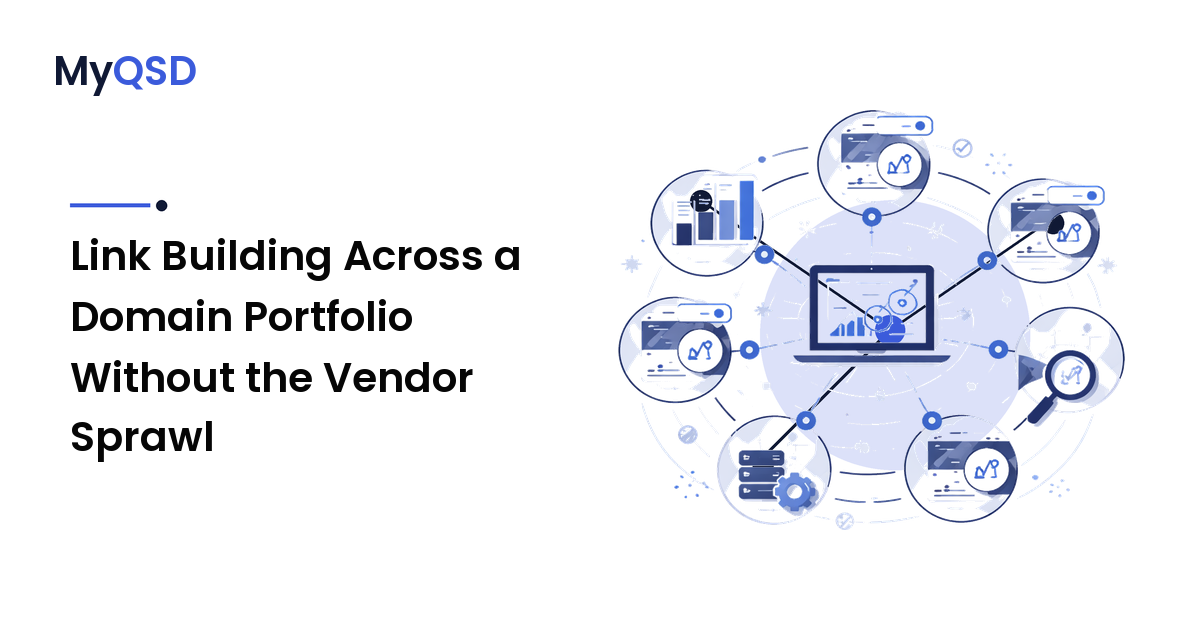
Managing one domain's link building is a project. Managing ten is an administrative mess. Each site needs its own steady flow of links, its own anchor plan, its own pacing — and if you're sourcing that production per-site from whichever freelancer or service you found for each one, the overhead multiplies fast. Different turnaround times, different quality bars, different balances to top up, a stack of invoices, and no single view of what's been built where. The link building itself isn't the hard part at portfolio scale. The coordination is.
The takeaway up front: a portfolio doesn't need a vendor per domain. It needs one consolidated source of production that every domain draws from, with the per-site judgement kept separate. Centralize the supply and the operations; keep the strategy decentralized where it belongs.
Why per-site vendor sprawl breaks at portfolio scale
A single vendor relationship has fixed costs that don't feel like much for one site: vetting them, learning their ordering process, funding a balance, tracking what they delivered. Multiply that by every domain and the costs stop being trivial.
The specific failures show up in a few ways. Inconsistent quality — each vendor produces to a different standard, so your portfolio's link profiles vary in ways you can't easily control. Operational drag — topping up five balances and reconciling five invoices is real time that produces nothing. No portfolio view — you can't answer "how many links did we build across all sites this month, and where?" without assembling it by hand. Fragile supply — when one vendor goes quiet, the domain that depended on them stalls.
None of these is about the links being bad. They're about the structure being wrong for the number of domains you're running. A structure that works for one site quietly becomes the bottleneck at ten.
Separate the two layers: strategy per domain, production shared
The fix starts with a distinction that's easy to blur. Link building across a portfolio has two layers, and they want opposite treatment.
Per-domain — keep it separate: Each site has its own niche, its own target pages, its own anchor profile and risk tolerance. A clean profile for one domain isn't a template you stamp across the others — uniform anchor patterns across a portfolio are themselves a footprint. This layer is judgement, and it stays domain-specific.
Shared — consolidate it: The production — actually placing the links, building the citations, handling indexing — is the same kind of repetitive labor regardless of which domain it's for. There's no reason to source it from a different place per site. This is the layer to centralize.
Keeping these straight is also what stops portfolio link building from drifting into network spam. You're not interlinking the domains or treating them as one entity; each gets its own independent, naturally-paced profile. You're only sharing the supplier, not the link graph. The same care that goes into keeping a portfolio of domains healthy in the first place — covered in our domain management guide — applies here: each domain stands on its own.
Consolidate production behind one reseller account
Once production is the shared layer, the question is where to centralize it. Sourcing all of it from a single reseller account solves most of the sprawl in one move: one balance to fund, one quality standard to learn, one dashboard showing what's been built across every domain.
A long-running example is SEOeStore, a wholesale marketplace that offers link building, citations, directory submission, bookmarking, and indexing as catalog services behind a single reseller account. The reason it fits the multi-domain case specifically is the consolidation plus the wholesale model: every domain in the portfolio draws its production from one place at per-unit prices, so instead of managing a vendor per site you manage one account that serves them all — and the per-unit pricing leaves margin if you're running domains for clients rather than yourself. You order per domain, but you source from one supplier, which is exactly the shape a portfolio wants.
This doesn't merge your domains' strategies — you still write a separate brief, with separate targets and anchors, for each site. It merges only the supply chain behind them.
Use the API to make a portfolio actually scale
The single-account benefit goes further once a reseller API enters the picture, because manual ordering is where portfolio overhead quietly returns. Filling out order forms by hand is fine for one site; across ten, it's the new bottleneck.
A reseller API lets you wire ordering into your own process: a script or internal tool that, given a domain and a brief, places the right production order without anyone touching a form. That's what turns "one account for all domains" into genuine scale — you can run each domain's pipeline on its own schedule, programmatically, from one integration. For an operator managing a portfolio, the API is often the difference between consolidation that saves a little time and consolidation that removes the manual work entirely. As always, the API places the order; it doesn't decide the strategy. Per-domain briefs and pacing stay your call.
Keep it safe across the whole portfolio
Consolidating supply doesn't relax the quality discipline — it makes it easier to apply consistently:
- Distinct profiles per domain. Vary link types, sources, and anchors across sites. Don't let one supplier's defaults create an identical footprint on every domain.
- Pace each domain independently. Each site grows on its own natural-looking calendar, not a synchronized portfolio-wide burst.
- Test new service tiers once, apply everywhere. A small test order tells you a tier's quality; once it passes, you can trust it across the portfolio — one of the real upsides of a single supplier.
- Review the portfolio view monthly. Use the single dashboard to check that no domain is over- or under-served and that velocity stays natural everywhere.
FAQ
Can I use one SEO account to build links for multiple client sites?
Yes — that's a core reason reseller accounts exist. You fund one balance and place separate, per-site orders, with white-label delivery so the work drops into each client's reporting unbranded. The accounting and supply are centralized; the link profiles stay independent per site.
Does sourcing links for many domains from one place create a footprint?
It can if you let the supplier's defaults produce identical profiles. The footprint risk is in the links — same sources, same anchors, same pacing across sites — not in the shared account. Vary each domain's brief and pacing and you avoid it. The supplier is shared; the link graph is not.
Is buying link-building services across a portfolio against guidelines?
Buying links to manipulate rankings is against guidelines, whether it's one site or many. Sourcing the production of relevant, naturally-paced links to legitimate pages is an operational choice. The risk lives in quality, relevance, and velocity per domain — keep each profile clean and independent and the number of domains doesn't change the principle.
Is an API worth it for a small portfolio?
For two or three domains, manual ordering is usually fine. The API earns its keep once the number of orders per month makes form-filling a real time cost — typically when you're running several domains on continuous pipelines. Consolidate the account first; reach for the API when manual ordering becomes the bottleneck.
Consolidate the supply, keep the strategy split
Audit how you currently source link production across your domains. If it's a different vendor, balance, and invoice per site, that's the overhead to remove. Keep each domain's strategy and pacing separate, then point all the production at one place — open a reseller account with a wholesale marketplace like SEOeStore, run a small test order for one domain, and once the quality checks out, consolidate the rest behind it. A portfolio scales when the supply is shared and the judgement stays per-domain.